Why Every Live Sound Engineer Should Embrace the Humble Checklist
Amidst the chaos and pressure of live event production, who has time for a checklist?
There’s just no room for paperwork, damn it!
Well, buckle up, because I’m about to convince you that checklists are not just for airline pilots and astronauts. They’re the unsung heroes that can transform your shows from “Survived it” to “Nailed it!”
The Day the Mics Went Silent
Do you like scary stories? A project manager recently called me, equal parts grateful and exasperated. He thanked me for my work on one show and then complained about another. Apparently the A1 on that event was asked three times to set up a wired backup mic. Each time, he nodded and said he’d do it.
Showtime arrived, and—surprise!—every RF mic decided to go offline due to some mysterious interference. The project manager reached for the wired backup, only to find…nothing. The A1 hadn’t set it up. Stress ensued.
Would I have remembered to set up that backup mic? Maybe. But maybe not. I have a pretty bad memory and acknowledging that fact forces me to write everything down. Relying solely on memory in the high-stakes, fast-paced environment of live events is like juggling chainsaws blindfolded. It’s too risky.
Enter the humble checklist—a simple tool that could have saved the day and a few reputations.
The Checklist Manifesto: Not Just for Surgeons
Atul Gawande’s book, The Checklist Manifesto, isn’t just a bestseller; it’s a revelation. One of the key takeaways is that checklists free up your brain to focus on the unexpected by ensuring the routine stuff doesn’t get overlooked.
- Memory and Judgment Are Flawed: Even the most seasoned professionals can miss critical steps when under pressure.
- Checklists Foster Team Communication: They encourage everyone to be on the same page, quite literally.
- They’re Not Micromanagement Tools: Checklists aren’t about telling you how to do your job; they’re about making sure the essential steps are covered so you can shine where it counts.
Van Halen and the Brown M&Ms
Ever heard the story about Van Halen demanding all the brown M&Ms be removed from their dressing room? It wasn’t rockstar vanity; it was a clever safety check. If the band found brown M&Ms backstage, they knew the promoter hadn’t thoroughly read the technical rider, and their gear might not even fit in the room.
Similarly, a checklist acts as your early warning system. If something simple is overlooked, what bigger issues might be lurking beneath the surface?
From Firefighting to Fine-Tuning
In poorly produced events, you’re often stuck in firefighting mode—chasing down issues, patching holes, and praying the audience doesn’t notice. With checklists, you transition from merely surviving the event to optimizing the experience.
- Reduce Cognitive Load: Free your mind from tracking mundane tasks so you can focus on real-time problem-solving and creativity.
- Consistency Across Teams: Checklists provide a standardized way of doing things, which is invaluable when working with new or rotating staff.
- Empowerment Through Clarity: Knowing what’s expected allows everyone to perform confidently, reducing stress and increasing job satisfaction.
The GitHub Repo That Could (But Probably Won’t)
I started a GitHub repository of checklists with the grand idea of creating a collaborative hub for live sound engineers. In the end, I decided to keep my personal checklist in Workflowy, where I keep everything else, but the repo still stands as an example of what’s possible.
Feel free to fork it, improve it, or use it as inspiration to create your own checklists tailored to your workflow.
Try It Out—What Do You Have to Lose?
Implementing checklists doesn’t require a massive overhaul of your current process. Start small:
- Identify Repetitive Tasks: Think about the routine steps that, if missed, could derail a show.
- Create a Simple Checklist: Keep it concise—focus on the critical items. 5-9 items is the limit of working memory.
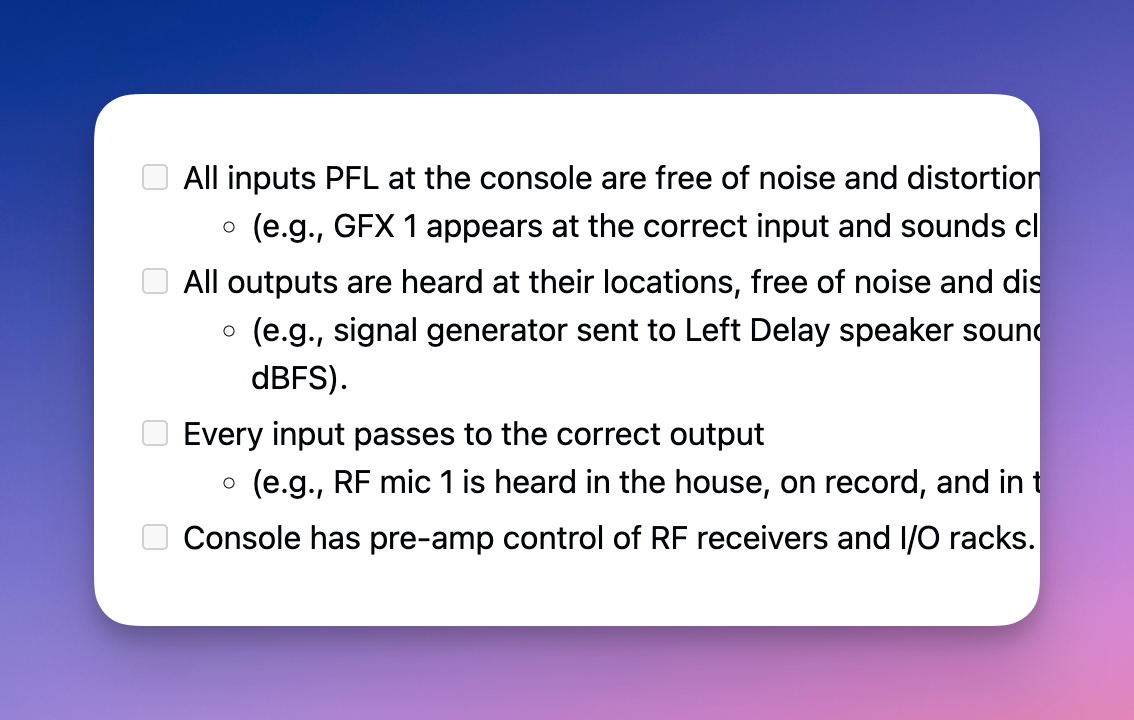
- Outcomes are key: I have plenty of checklists for how I like to get stuff done, but for a generalized list for everyone, it’s probably best to focus on the expected outcomes. (eg. All outputs are heard at their locations.)
- Test and Refine: Use it in a real-world setting and adjust as needed.
As Gawande suggests, ask yourself: If you were the one going under the knife (or in our case, stepping onto the stage), would you want the team to use a checklist?
Let’s Make Great Productions Inevitable
The goal isn’t to clip your wings but to give you a stronger wind beneath them. By embracing checklists, we shift from a culture that glorifies last-minute heroics to one that values consistent excellence.
So, the next time you’re prepping for a show, consider giving a checklist a whirl. Who knows? It might just be the secret ingredient that takes your performance—and your peace of mind—to the next level.