Adventures in Alignment 3: Rapid Response
Last week was my second time doing sound for president Biden and my second time for vice-president Harris. The first for Biden was last year at a missile facility and the first for Harris was three years ago at a campaign rally in McAllen, TX.
There was an interesting alignment challenge that came up during the event, but first just a couple of notes about the circumstances:
- Events for the White House make a simple podium mic gig a lot more intense.
- There were two AV companies in the room, duplicating all light, sound, and video.
I’m still surprised how a seemly simple system with a single VIP input and a few outputs can feel intense. The biggest reason is the number of stakeholders. The audience in the room wants to be happy along with everyone in the press pool, the white house recorders, white house mission control, and in-house AV that is streaming on their end. Every time a stakeholder has a question or criticism about the noise or sound quality on their end, I have to consider every link in the signal chain to them. Plus, what their listening environment might be like. The final challenge is that of these needs are being handled from a mid-tier live sound console with eight matrices and no output processor. Hurray!
The second thing that turned up the pressure at this event was the presence of another AV company in the room. They were there to do sound for the multi-day conference, while we there only for the president and vice president’s remarks. I suppose with more planning we could have divided up the responsibilities and brought less gear, but since it was all fairly last minute (I got the call the day before load in), two companies showed up with two trucks full of gear and set up two complete AV systems.
While it added some stress to the event to negotiate for the little available space in this theater, it also gave us the unique opportunity to almost do an apples to apples comparison of two sound systems. It was like a system shootout, but in a real life application.
The results were surprising. I really thought that my superior speaker placement, aim, EQ, and alignment would stand out against our colleagues. I expected showers of praise. 👏🏽 At the end of the day, the main thing that the audience would notice is that our sound system was quieter. In the end, you can’t beat close miking. Their podium goosenecks had a good 8 inches on ours, which is a world of difference in the fight of gain before feedback in corporate audio.
The interesting thing that happened with alignment was adding a second set of fill speakers at the alst minute. My crossover alignment procedure for full-range sources starts with solo source EQ, searching for the acoustic crossover point while watching the impulse response graph, synchronizing them with delay, then confirming summation and combined EQ.
This time we didn’t have time for that. We needed to set up two extra fill speakers half way down the room and we only had a few minutes to do it. We had JBL VRX932 or QSC K10. The K10 would have probably been a better fit for the coverage shape, but in the moment I couldn’t remember if they were phase compatible while there would be no question with the VRX932, which matched the mains.
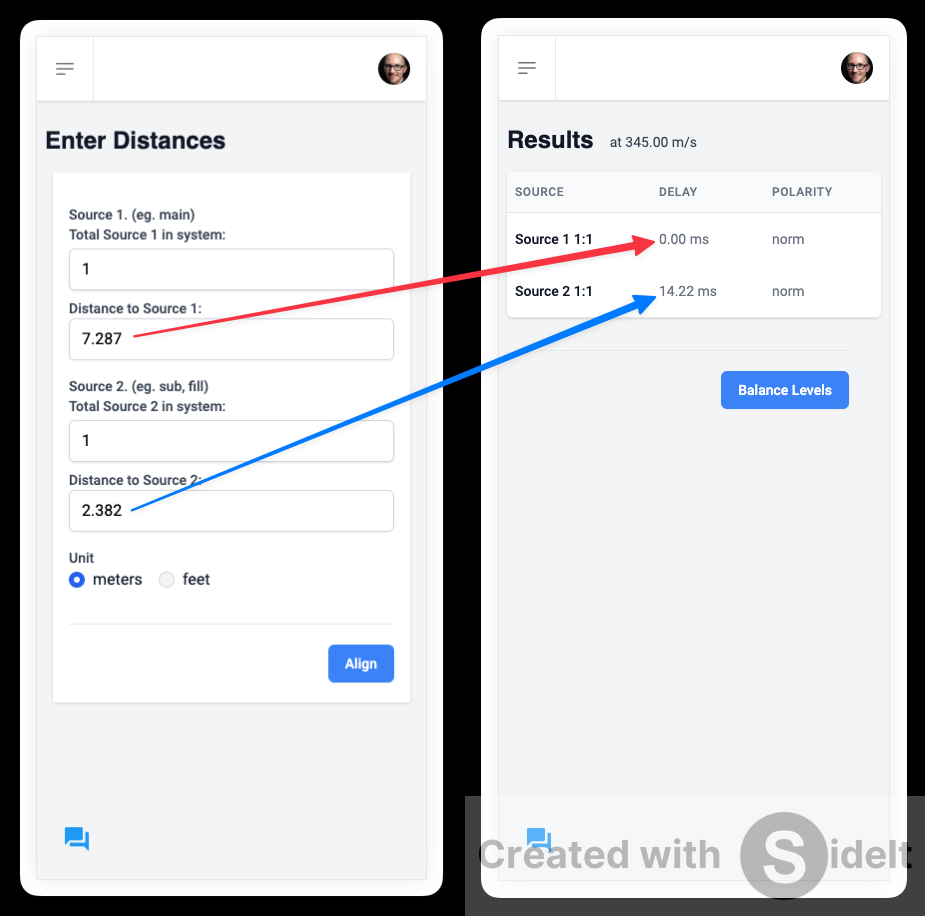
“Hold on for a second while I go setup my audio analyzer and get my measurement mic and my tablet,” was what I started to say, but then I realized I could do it a lot faster with SubAligner. I used the same matrix output as the other fill speakers to save time on EQ, gave it a quick solo listen to make sure nothing jumped out, then turned main and fill on together and walked around to find the seat where they could be heard at equal level (aka the acoustic crossover). I took measurements with my laser disto (thanks JBL for the shiny horn), put those into SubAligner using the 1:1 preset, put the suggested delay value into my outport setting, did a quick listening test of the combined system and was done with the entire calibration in about 90 seconds.

The one thing that really slowed me down on this show was the QL Stagemix app. There are a lot of settings missing from it. I rely pretty heavily on the premium rack plugins, for example, which are not accessible from the app.